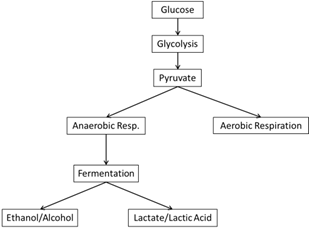
Many organisms (or cells) will use aerobic respiration primarily, however, if there is a limited oxygen supply they can utilize anaerobic respiration for survival. Although there are some organisms (or cells) that always require anaerobic respiration and others that will always require aerobic respiration. Anaerobic respiration has fewer steps, so let’s start there.
Anaerobic Respiration
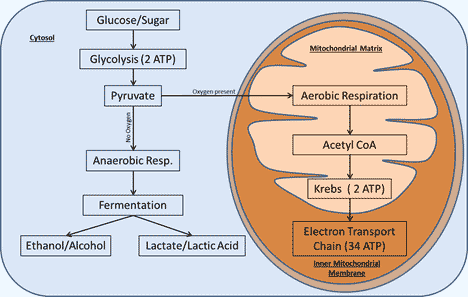
The first step in both anaerobic and aerobic respiration is called glycolysis. This is the process of taking one glucose (sugar) molecule and breaking it down into pyruvate and energy (2 ATP). We will discuss this in depth during aerobic respiration.
The second step in anaerobic respiration is called fermentation. Fermentation starts with pyruvate (the end product of glycolysis). Depending on the organism, pyruvate can either be fermented into ethanol (a fancy name for alcohol) or lactate (lactic acid). Fermentation releases CO2, but does not make any ATP – all ATP during anaerobic respiration is produced during glycolysis. Since glycolysis produces 2 ATP, anaerobic respiration yields 2 ATP for every molecule of glucose. Both glycolysis and fermentation take place within the cytosol/cytoplasm of a cell. In fact, the entire process of anaerobic respiration takes place in the cytosol.
Fermentation is the process by which we make wine and other types alcohol. Through an anaerobic process, yeast will break down the glucose in the grape juice and convert it into pyruvate. The pyruvate is then fermented into ethanol/alcohol. During anaerobic respiration CO2 is also released, this is why there are bubbles in wine and champagne (the release of CO2 during anaerobic respiration is also how yeast causes bread to rise). Of course, other organisms and bacteria can utilize this method of respiration as well, but yeast is the organism of choice for making wine.
Other cells and organisms will ferment pyruvate into lactate, also known as lactic acid. I’m sure you’ve all been told that your muscles hurt during and after exercise because you have an excess build of lactic acid in your muscles. This is because of anaerobic respiration. During exercise, the oxygen supply to our muscle cells is limited. When oxygen is low, our muscle cells will utilize anaerobic respiration and ferment pyruvate into lactic acid. With rest and time, our body will eliminate the lactic acid and our muscles will no longer be sore. When we aren’t exercising, our muscle cells primarily use aerobic respiration because oxygen is plentiful.
Here’s what you need to know so far:
Now let’s talk about aerobic respiration. This is more efficient because it makes more energy (or ATP) for every molecule of glucose. However, aerobic respiration can only be utilized in the presence of an ample oxygen supply.
Cellular Respiration Equation
In order to understand cellular respiration we first need to understand the basic chemical equation. Think about what you do when you’re tired and need more energy to stay awake. You yawn, which takes in a lot of oxygen, or O2, and you drink something with a lot of sugar, like Mountain Dew. A scientific term for sugar is glucose and the chemical formula for glucose is C6H12O6. We need O2 + C6H12O6 for energy to stay awake, just like we need O2 + C6H12O6 in order for cellular respiration to take place.
Now let’s think about what happens to the oxygen we inhale after a big yawn. It goes to our lungs to get utilized and we breathe out carbon dioxide, or CO2. Mixed with the carbon dioxide are water droplets, or H2O. That’s why our breath fogs up the glass when we exhale onto the car window.
Putting all this information together we get glucose plus sugar makes carbon dioxide, water, and energy. This is the cellular respiration equation:
C6H12O6 + 6O2 --> 6CO2 + 6H2O + ATP
glucose + oxygen --> carbon dioxide + water + energy
In this equation, 6 is the magic number. There are 6 oxygen, 6 carbon dioxide, and 6 water molecules. There are also a couple sixes in our formula for glucose. Remember the number 6 when writing this equation.
Eventually we need to recycle the CO2 and H2O so there is more glucose and oxygen for future cellular respiration and energy production. That’s where plants come in, with photosynthesis. The equation for photosynthesis is almost the exact opposite of the equation for cellular respiration:
6CO2 + 6H2O + light --> C6H12O6 + 6O2
carbon dioxide + water + light --> glucose + oxygen
We will save the discussion of photosynthesis for a future lesson.
If you understand everything up to this point, you are already 50% there.
Let's keep going...
Glycolysis
The first step in cellular respiration is
glycolysis, or the breakdown of glucose. The naming of this process is actually very logical. Glycolysis literally means the breakdown of glucose. If we know that ‘glycose’ is an older term for ‘glucose’ and if we remember ‘lysis’ means to breakdown, then we can understand that glycolysis = glycose + lysis, or the breakdown of glucose.
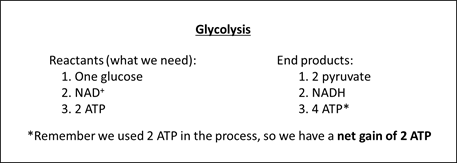
Glycolysis is the first step in cellular respiration for both anaerobic and aerobic processes. Glycolysis takes place in the cytosol of a cell. In the cytosol we convert 1 molecule of glucose into 2 molecules of pyruvate. Of course glucose can’t be converted into pyruvate without a little bit of help. This conversion requires 2 NAD+ and some energy, in the form of 2 ATP. Once glycolysis is completed, we are left with 2 pyruvate, 2 NADH, and 4 ATPs as products. Since glycolysis yields 4 ATP, but we had to use 2 ATP in the beginning of the process, the total Net Gain of energy is 2 ATP. The cell will use the 2 ATP for energy. NADH will be recycled back to NAD+ in a future process so that it can be used in glycolysis again. The 2 pyruvate molecules will be used for the second step of cellular respiration.
Krebs Cycle/ Citric Acid Cycle/TCA cycle





No comments:
Post a Comment